
Intimate Image Abuse Research Reveals Rising Reports but Low Charge Rates
by Fflur Jones, Senior Policy and Research Officer
Note: throughout this research we use ‘survivors’ to refer to our service users and those with lived/living experience of intimate image abuse; ‘victims’ is only used where this reflects police and/or criminal justice terminology
In January 2026, concerning reports emerged that the social media platform X’s artificial intelligence (AI) chatbot, Grok, was being used to generate and circulate undressed images of real individuals.1 In response to mounting pressure from organisations within the violence against women and girls (VAWG) sector and alongside widespread public concern, the UK’s independent online safety regulator, Ofcom, made an initial assessment that such outputs could constitute intimate image abuse under existing criminal law.2
These developments highlight an increasingly urgent concern: the rising prevalence of technology-facilitated abuse targeting women and girls, including intimate image abuse. This research examines the extent to which intimate image abuse offences are being reported, investigated, and charged by police forces across England and Wales, drawing on new data obtained through Freedom of Information (FOI) requests. Intimate image abuse, sometimes referred to as ‘revenge porn’, involves perpetrators sharing, threatening to share, taking or creating intimate or sexual images and videos (including digitally altered or ‘deepfake’ images) of an individual without their consent. It is widely recognised as a form of gender-based abuse, often perpetrated in domestic abuse contexts as a tool of coercive control, used to intimidate, humiliate, or exert power over survivors.
To better understand how the criminal justice system is responding to these offences, Refuge gathered data from police forces on reporting levels and case outcomes. The findings point to significant gaps between the scale of abuse and the likelihood of cases progressing through the justice system.
While the data from our FOI analysis highlights ongoing gaps in the criminal justice response in the last 5 years, these challenges are not new. Refuge established its specialist Technology-Facilitated Abuse and Economic Empowerment Team (referred to here as the tech team) in 2017 to provide support to women experiencing abuse enabled or exacerbated by digital technologies. The team regularly hears from survivors that the impacts of intimate image abuse are severe and wide-ranging. Survivors frequently experience significant harm to their mental health and physical safety, as well as experiencing social isolation, reputational damage, and economic harm.3 These impacts are often exacerbated where images are disseminated to family members, employers, or wider social and professional networks.
The Evolving Legislative Framework
The legislative response to intimate image abuse in England and Wales has developed significantly over the past decade. Prior to specific offences, survivors relied on a patchwork of legal provisions including harassment and malicious communications legislation which were often insufficient to address the specific nature of intimate image abuse. This changed with the Criminal Justice and Courts Act 2015, which introduced a dedicated offence of disclosing private sexual photographs or films without consent and with intent to cause distress. However, this framework did not initially criminalise threats to share intimate images, despite their well-documented use as a form of coercive control.
In response to an increase in survivors reporting that their perpetrator was threatening to share intimate images of them and that the police were failing to take action, Refuge campaigned during the passage of the Domestic Abuse Bill for the offence to be extended to include threats to share private and sexual photographs or films without the person’s consent.4 Thanks to this campaign, and the survivors who spoke out about their experiences, the government agreed to use the Domestic Abuse Act 2021 to amend Section 33 of the Criminal Justice and Courts Act 2015 to criminalise threats to share intimate images.
Subsequent legislative developments have continued to strengthen this framework. In 2023, the Online Safety Act introduced a more nuanced, graded offence structure, with a base offence of sharing intimate images without consent, and new intent-based sharing and threats to share offences. It also expanded the scope of the law to explicitly include digitally altered images, and designated sharing and threatening to share intimate images ‘priority offences’ under the Act, requiring tech companies to take proactive steps to protect their users from this content. More recently, the creation of, and requests to create, deepfake non-consensual intimate images were criminalised via the Data (Use and Access) Act 2025, and the offence came into force earlier this year.
The government has also announced a host of reforms within the Crime and Policing Bill (which is currently passing through Parliament) in order to strengthen the response to non-consensual intimate image (NCII) abuse.5 These include amendments to improve reporting and tracking mechanisms for NCII content, a mandatory 48-hour takedown requirement once material is identified, measures addressing ‘nudification’ tools and other AI technologies capable of generating non-consensual intimate images, strengthened platform accountability for compliance with removal duties, and consideration of senior executive responsibility where statutory takedown timeframes are not met.
Although Refuge welcomes the strengthening of the legal framework on intimate image abuse, experience from our tech team demonstrates that legislative change alone is not sufficient to protect survivors in practice. Many of the women we support report receiving inadequate responses when reporting these offences to the police. This includes experiences of victim-blaming and cultural insensitivity, alongside limited understanding of the dynamics, harm, and risks of technology-facilitated abuse. In some cases, women whose perpetrators had threatened to share intimate images were not effectively protected under the relevant offence, with some told by officers that action could only be taken once images had actually been shared. Others have been advised to return to the police only after further harm has occurred, reflecting significant gaps in the practical application of the law and its protective intent.
What We Did
29th of April 2026 marks five years since the Domestic Abuse Act 2021 became law and subsequently threats to share intimate images became a crime. To mark this anniversary, Refuge built on previous research conducted in 2023 examining the number of intimate image abuse offences reported and their outcomes across police forces.6
To understand how these offences are being recorded and progressed in practice, Refuge submitted Freedom of Information (FOI) requests to all 43 police forces in England and Wales. We received responses from 27 forces, with 25 providing a breakdown of case outcomes.
Table 1: Police forces responses to Refuge’s FOI requests
Please note that some police forces have since sent the requested data, but this fell out of the timeframe required to be included in the analysis as it was past the 20-working day response deadline.
We requested year-on-year data from July 2021 to February 20267 on the total number of offences recorded, breakdowns of the outcomes (including charges and the cases closed due to evidential difficulties and/or victim withdrawal)8, and the number of cases specifically involving threats to share intimate images. We also asked for a gender breakdown of the victims. For this analysis, only complete responses were included, with findings primarily based on the 25 police forces that provided detailed outcome data unless otherwise stated (see table 1 for a breakdown of response rates and table 2 for a complete breakdown of those responses force by force).9
| Police Force | Data Provided | Included in analysis? |
|---|---|---|
| Avon and Somerset Police Force | No | No |
| Bedfordshire | Yes | Yes |
| Cambridgeshire | Yes | Yes |
| Cheshire | Yes | Yes |
| City of London | Yes | Yes |
| Cleveland | Yes | Yes |
| Cumbria | Yes | Yes |
| Derbyshire | No | No |
| Devon and Cornwall | Yes | Yes |
| Dorset | No | No |
| Durham | Yes | Yes |
| Dyfed-Powys | Yes | Yes |
| Essex | No | No |
| Gloucestershire | No | No |
| Greater Manchester | Yes | Yes |
| Gwent | Yes | Yes |
| Hampshire | Yes | Yes |
| Hertfordshire | Yes | Yes |
| Humberside | Yes | Yes |
| Kent | No | No |
| Lancashire | Limited data provided | No |
| Leicestershire | No | No |
| Lincolnshire | No | No |
| Merseyside | No | No |
| Metropolitan Police Service | No | No |
| Norfolk | Yes | Yes |
| North Wales | Yes | Yes |
| North Yorkshire | Yes | Yes |
| Northamptonshire | Yes | Yes |
| Northumbria | No | No |
| Nottinghamshire | Yes | Yes |
| South Wales | Yes | Yes |
| South Yorkshire | Different timeframe provided | No |
| Staffordshire | Yes | Yes |
| Suffolk | Yes | Yes |
| Surrey | Yes | Yes |
| Sussex | Yes | Yes |
| Thames Valley | No | No |
| Warwickshire | No | No |
| West Mercia | Yes | Yes |
| West Midlands | Limited data provided | No |
| West Yorkshire | Yes | Yes |
| Wiltshire | Yes | Yes |
Table 2: Charging rates by police force between July 2021 and February 2026 as per Refuge’s FOI requests
Please note that City of London and Sussex Police are not included in the overall total and analysis of reporting trends because either they did not provide outcomes or the outcomes fall under a different category not being assessed in this reaserch.
| Police force | Number of offences charged or summonsed | Number of overall intimate image abuse offences recorded (July 2021-February 2026) | Rate |
|---|---|---|---|
| Bedfordshire | 30 | 594 | 5.1% |
| Cambridgeshire | 34 | 718 | 4.7% |
| Cheshire | 94 | 907 | 10.4% |
| Cleveland | 36 | 564 | 6.4% |
| Cumbria | 17 | 370 | 4.6% |
| Devon and Cornwall | 41 | 1,384 | 3.0% |
| Durham | 15 | 545 | 2.8% |
| Dyfed-Powys | 1 | 112 | 0.9% |
| Greater Manchester Police | 105 | 2,917 | 3.6% |
| Gwent | 28 | 633 | 4.4% |
| Hampshire | 85 | 1,402 | 6.1% |
| Hertfordshire | 27 | 680 | 4.0% |
| Humberside | 34 | 740 | 4.6% |
| Norfolk | 78 | 929 | 8.4% |
| North Wales | 37 | 664 | 5.6% |
| North Yorkshire | 17 | 474 | 3.6% |
| Northamptonshire | 18 | 442 | 4.1% |
| Nottinghamshire | 46 | 879 | 5.2% |
| South Wales | 56 | 1,070 | 5.2% |
| Staffordshire | 28 | 966 | 2.9% |
| Suffolk | 38 | 598 | 6.4% |
| Surrey | 27 | 442 | 6.4% |
| Wiltshire | 24 | 475 | 5.1% |
| West Mercia | 33 | 816 | 4.0% |
| West Yorkshire | 98 | 2,604 | 3.8% |
| Total | 1,047 | 21,905 | 4.8% |
What We Found
The majority of victims were women
Between July 2021 and February 2026, there were 20,404 recorded intimate image abuse offences where the gender of the victim was known among the 25 police forces that provided outcome data. In 76.2% of cases (15,564), the victim was female.10 This aligns with wider evidence that intimate image abuse is a form of gender-based violence that disproportionately affects women and girls.
Despite an overall increase in recorded offences, the charge rate has decreased since 2021
Between the year ending June 2022 and the year ending June 202511, recorded intimate image abuse offences rose by 26.9% overall among the 25 police forces that provided outcome data, rising from 4,058 offences in 2021/22 to 5,151 in 2024/25.12 This upward trend was particularly marked between the year ending June 2024 and June 2025, when recorded offences increased by 25.8%. Notably, between July 2025 and February 2026, there have already been more offences recorded (4,065) than in all of the year ending June 2022 (4,058). Whilst the increase indicates the continued prevalence of intimate image abuse, it could also suggest that the law is capturing intimate image abuse offences more accurately and that a growing number of survivors are coming forward to report to the police.
However, despite this increase in recorded offences, the number of perpetrators charged per year remained flat (236 in the year ending June 2022 compared to 233 in the year ending June 2025). In real terms, this means charging rates remain consistently low and have declined over time. The proportion of cases resulting in a charge or summons fell from 5.8% in 2021/22 to 4.5% in 2024/25. This indicates that only a very small fraction of recorded cases progress to prosecution, meaning many survivors do not see their cases resolved through the criminal justice system.
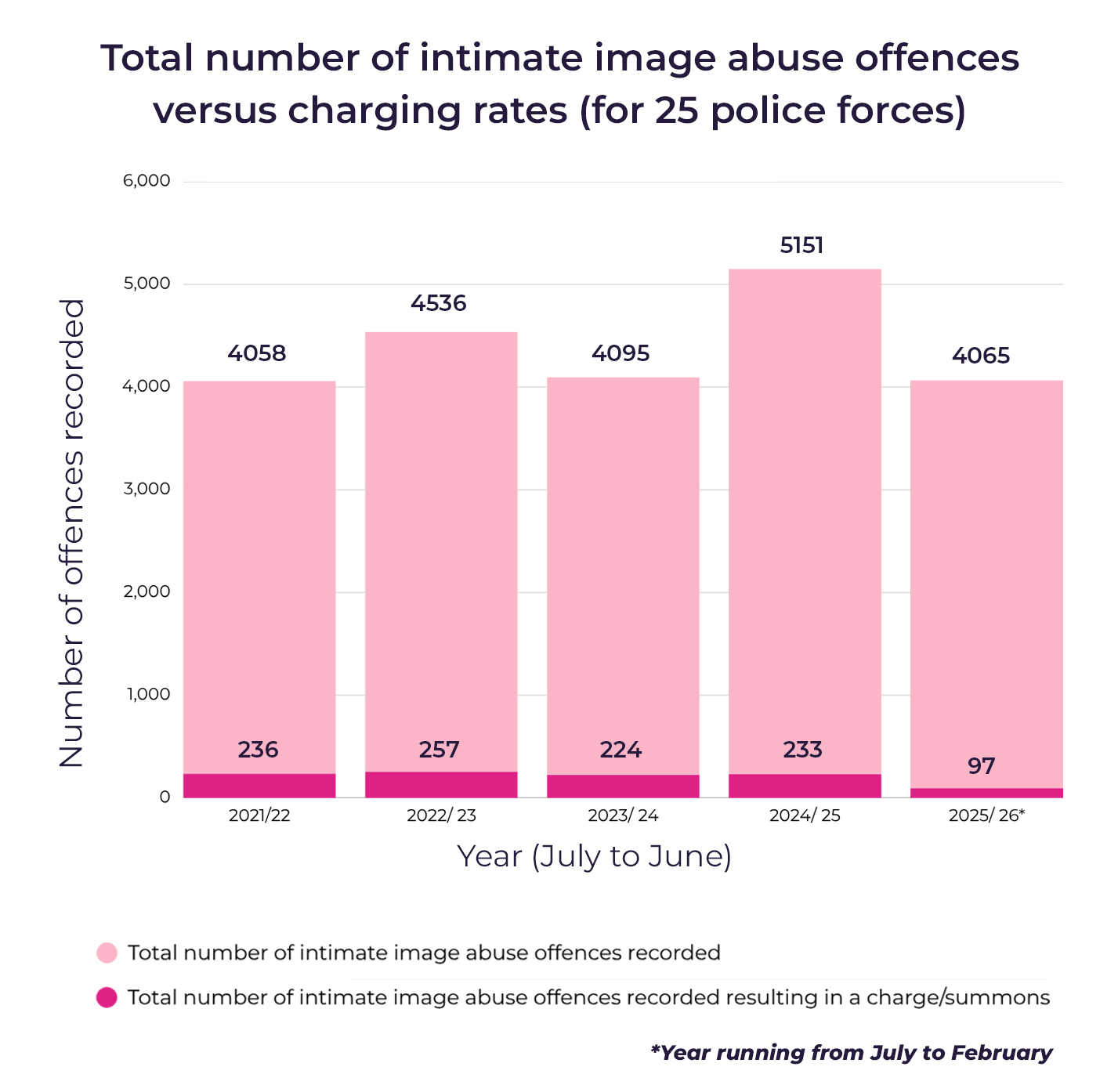
Taken together, these findings show a widening and concerning gap between rising reports of intimate image abuse and a stagnating number of cases resulting in a person being charged. While reporting has increased significantly, progression through the criminal justice system has not kept pace.
Despite the suspect having been identified, many cases do not end up in a charge
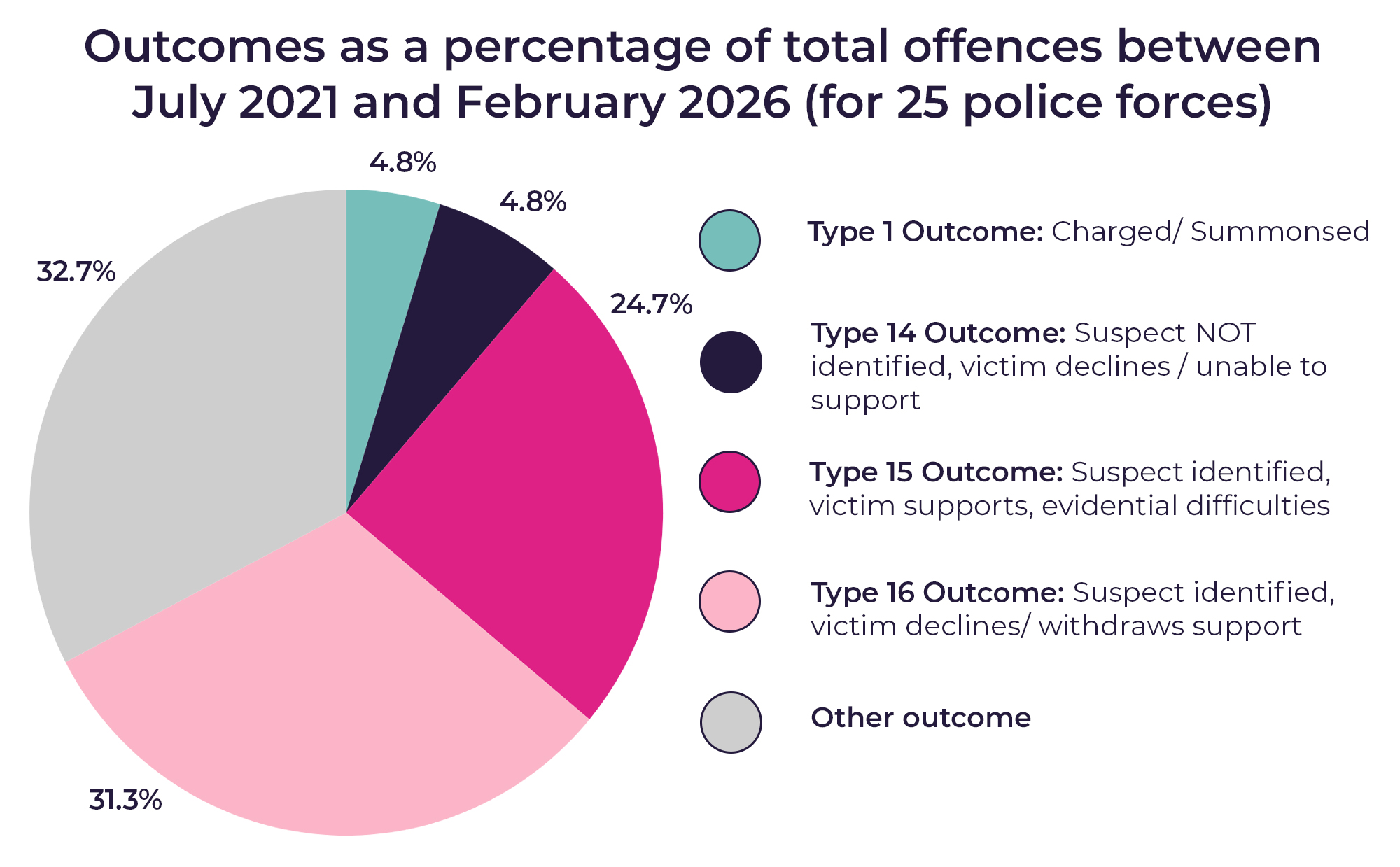
Of the 21,905 intimate image abuse offences recorded by the 25 police forces between July 2021 and February 2026, nobody was charged in 56% (12,265) of cases despite the suspect having been identified. A key factor driving case attrition is victim withdrawal or inability to support the investigation further, which accounts for 55.8% (6,848) of cases where a suspect was identified. This suggests that a significant proportion of survivors disengage from the criminal justice process before cases can progress. While multiple factors may contribute to this, the high rate of withdrawal raises concerns about whether survivors are being adequately supported to remain engaged throughout investigations.
This pattern is consistent with wider concerns about survivors’ experiences when reporting to the police, particularly in relation to technology-facilitated abuse. Where survivors disengage, it may reflect not only a lack of confidence in the process but also shortcomings in the police response, including victim-blaming attitudes, dismissive or inappropriate language, and a failure to recognise the seriousness and context of intimate image abuse. As highlighted in the opening section, negative initial interactions with police officers when reporting can significantly undermine survivors’ trust in the criminal justice system.
Anecdotally, Refuge’s tech team supports survivors who report experiencing considerable victim-blaming from police officers, including suggestions that they ‘should not have shared the images in the first place’. This reflects a fundamental misunderstanding of how intimate images may have been obtained non-consensually, and that consensual sharing at one point in a relationship does not equate to ongoing consent. There is also a need for greater understanding among officers that intimate image abuse can occur both within relationships and as a form of post-separation abuse, where risks to survivors’ safety are often heightened.
Additionally, we know that some survivors feel anxious about the handling of their case, including concerns that intimate images may be viewed by multiple officers, which can be experienced as a further violation of privacy and be re-traumatising. There are also reported inconsistencies in how cases are handled, including survivors being required to recount their experiences multiple times or not being kept adequately informed of progress. Survivors may also fear retaliation from perpetrators, particularly where threats to share images are used as a form of coercive control. In some cases, a perceived lack of protective action by police can exacerbate these fears. In practice, these factors can mean survivors do not feel sufficiently supported or protected to continue pursuing action against perpetrators in cases involving intimate image abuse.
Separately, 25% (5,417) of total offences do not progress due to evidential issues, even though the suspect has been identified and the victim supports the investigation. This is consistent with insights from Refuge’s specialist tech team, who report ongoing uncertainty in parts of policing about the evidential requirements needed to progress intimate image abuse cases.
A key issue identified by our tech team is that survivors often do not themselves possess the intimate images, yet police can be slow or reluctant to obtain evidence directly from perpetrators’ devices. In some cases, survivors have been told that suspects will be invited to a voluntary initial interview, which leaves survivors fearing reprisals if no arrest is made and further provides perpetrators with an opportunity to destroy evidence. There have been instances where police have taken a survivor’s own device for evidential purposes rather than prioritising seizing the perpetrator’s device. Our tech team has also supported survivors where the police returned the perpetrator’s device without erasing its contents and simply advised the perpetrator not to reshare the images. This leaves harmful material accessible and does little to mitigate the risk of further abuse.
Refuge views issues around evidence collection, case progression, and perceived inaction by police forces as key reasons why some survivors choose not to continue engaging with the criminal justice process. In this context, disengagement can reflect not a lack of willingness to pursue justice but rather be a result of limited confidence in the process, leaving many survivors feeling as though they have few viable options for protection or resolution.
Despite rising reports of threats to share intimate images, there is little information available on the progression of these cases
Only 11 police forces were able to provide a breakdown of offences specifically recorded as threats to share intimate images.13 Across these forces, there were 10,960 recorded intimate image abuse offences in total, of which 21.4% (2,347) were classified as threats to share. This indicates that a significant minority of intimate image abuse cases involve threats rather than the sharing of images itself.
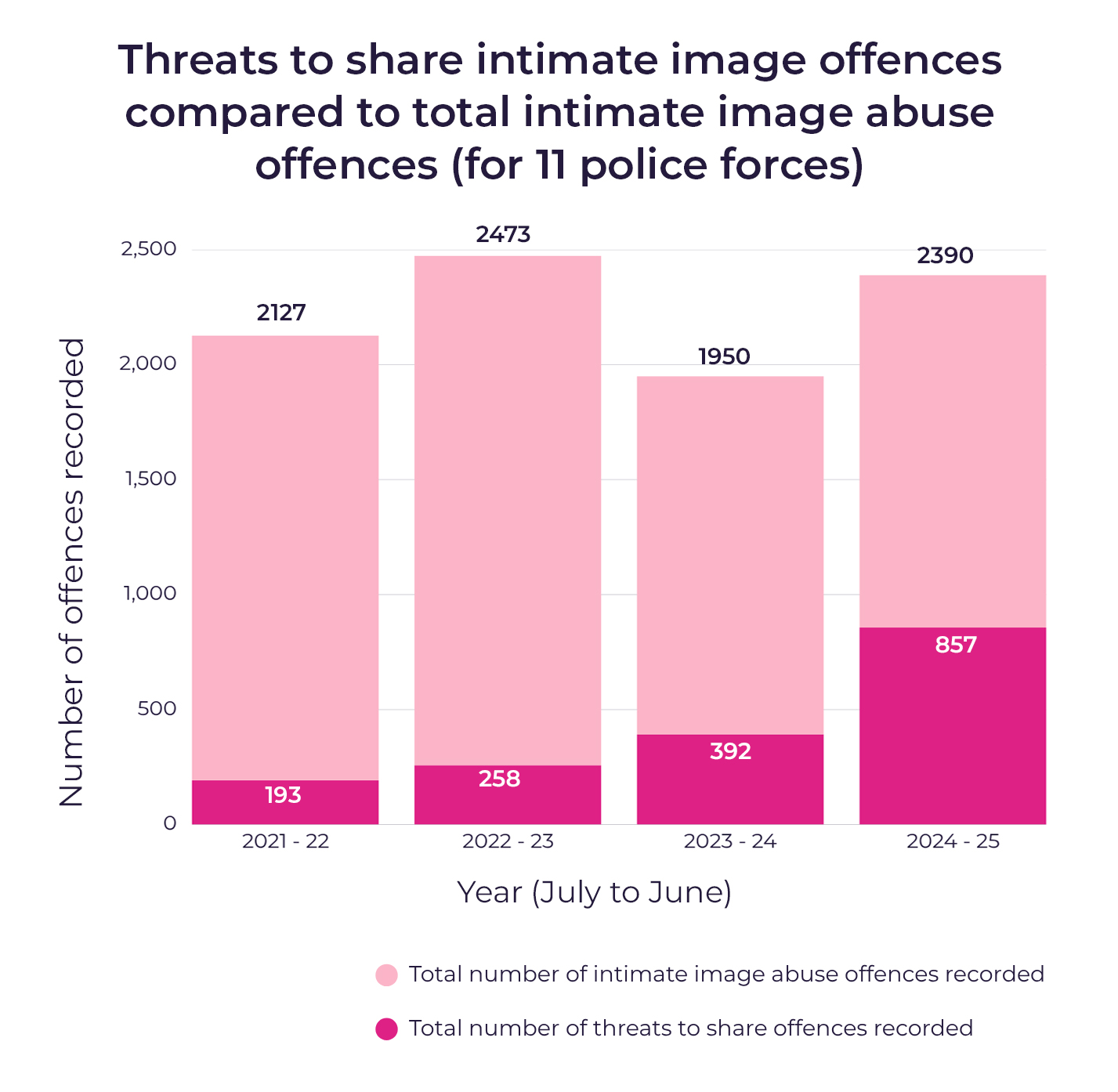
The data shows a substantial increase in recorded threats to share offences over time, rising by 344% between 2021/22 and 2024/25. In the eight months between July 2025 and February 2026, 647 such offences were already recorded, almost equivalent to the total recorded across both 2022/23 and 2023/24 combined (650). It is important to note that threats to share offences were not consistently captured in police data prior to a legislative change on the 31st of January 2024. Before this point, recording such offences was not a formal requirement, meaning earlier figures are likely to underrepresent the true scale. While some police forces were able to retrospectively identify and extract cases involving threats to share, this was not done uniformly, so part of the observed increase over time likely reflects improved recording practices following the legislative change rather than a strictly comparable rise across the full period. Nonetheless, the increase suggests there have been some improvements in the recognition and recording of this form of offending, alongside a possible rise in reporting by survivors.
However, the data on case outcomes remains extremely limited. Only 8 forces were able to provide detailed breakdowns of charging outcomes for threats to share.14 Others were either unable to extract the data within the scope of the FOI request or had reporting figures so low they could not be individually disclosed. Data from the 8 police forces that provided outcome breakdowns shows that the charge rate for threats to share intimate images between July 2024 and June 2025 was 5.1%, slightly higher than the charge rate for all recorded intimate image abuse offences across the 25 forces in the same period (4.5%).15 Since the introduction of the Domestic Abuse Act and the ‘threat to share’ offence, Refuge’s specialist tech team has not supported any survivors whose perpetrator has been convicted of threatening to share an intimate image, despite survivors reporting to the police. This small sample suggests that outcomes for threats to share offences are likely to be similarly limited or lower than the outcomes for other intimate image abuse offences. However, inconsistent recording practices preventing forces from being able to track outcomes for this offence type makes it difficult to fully assess how effectively these cases are being investigated and how successful the law has been since its implementation in 2021.
Recommendations
Despite the increased awareness and legislative reform, there has been a decline in the proportion of people charged for key intimate image abuse offences since 2021. Legislative progress is important but insufficient on its own and must be met with the training, resources and accountability needed so it makes a meaningful difference to survivors’ lives.
We welcome the government’s recent announcements to expand legislation on intimate image abuse and are pleased to see the increase in threats to share offences recorded by the police, which suggests the law change we campaigned for is having an effect. However, practice must keep pace with legislative change if confidence in the police and wider criminal justice system is to be rebuilt, and if survivors are to be able to access justice.
Our recommendations:
- Strengthen training and improve culture across policing and the criminal justice system
Refuge calls for consistent, mandatory training for police officers and all criminal justice agencies, including the Crown Prosecution Service, to ensure they are up to date with the rapidly evolving legislative landscape and confident in identifying and investigating intimate image abuse offences. We acknowledge the commitments made in the government’s Violence Against Women and Girls (VAWG) strategy published in December 2024 to improve police training; however, it is notable that these commitments do not explicitly address technology-facilitated abuse, including intimate image abuse.Any training should reinforce that intimate image abuse is frequently perpetrated within a domestic abuse context and is often part of a broader pattern of behaviour, including both physical and non-physical abuse. It must equip officers to respond appropriately and sensitively to survivors, including through culturally competent approaches that reflect the needs of marginalised groups, including Black and minoritised survivors, migrant survivors, disabled survivors and LGBTQ+ people.Decisive action is also required to address victim-blaming attitudes, misogynistic language and cultural insensitivity within policing to improve survivors’ confidence in reporting. - Ensure consistent national policing practice and equitable access to justice for survivors of intimate image abuseRefuge notes the significant variation in outcomes between police forces in relation to intimate image abuse offences, with some forces achieving considerably higher charging rates than others (see table 2). This points to inconsistent practice across England and Wales and raises concerns about unequal access to justice for survivors depending on where they report.We call on the National Centre for Violence Against Women and Girls and Public Protection to undertake further work to understand the factors driving these differences, including identifying and sharing effective best practice from higher-performing forces. This learning should be used to establish clearer expectations and consistent approaches to the investigation, prosecution and recording of intimate image abuse offences nationally.
- Strengthen digital evidence gathering capabilities within policing
As sharing and threats to share intimate images are primarily online offences, digital evidence is often available and may be used to evidence a wider pattern of coercive control, that may occur both online and offline. However, many cases are not progressing due to challenges in obtaining and effectively using this evidence. Police forces must therefore be adequately resourced and equipped to investigate technology-facilitated crime and to secure relevant digital evidence in a timely and effective manner. - Embed specialist survivor support and improve monitoring of outcomes
Survivors reporting intimate image abuse should be routinely referred to specialist VAWG services and helplines at the point of report. Police forces should work in partnership with specialist organisations to ensure survivors receive ongoing support throughout investigations.The National Centre for Violence Against Women and Girls and Public Protection should lead work to ensure transparent, routine reporting on case progression and attrition rates, including research to establish clear understanding of why cases are discontinued and adopt an intersectional approach to better understand and address the distinct barriers faced by marginalised survivors. Survivor feedback must be systematically captured as part of this work and used to improve police responses. - Strengthen regulatory accountability for online platforms
Ofcom must be backed by government to robustly and swiftly enforce the latest changes under the Online Safety Act once they come into force, including the effective regulation and investigation of social media platforms and their senior executives.We also call on the Government to upgrade Ofcom’s VAWG guidance to a legally binding code of practice to ensure that tech companies are continually held accountable for the role they play in allowing intimate images to be created and shared on their services and are required to implement ‘good practice’ mitigation measures or face enforcement action.
2 Ofcom launches investigation into X over Grok sexualised imagery
4 Refuge launches ‘The Naked Threat’ campaign
5 Crime and Policing Bill: government amendments for committee and report stage – GOV.UK
6 Intimate image abuse – despite increased reports to the police, charging rates remain low
7 N.B.: Each year runs July to June apart from the last year which runs July 2025 to February 2026
8 Charge / Summons: A person has been charged or summonsed for the crime; Outcome 14: Evidential difficulties victim based – named suspect not identified: The crime is confirmed but the victim declines or is unable to support further police action to identify the offender; Outcome 15: Evidential difficulties named suspect identified – the crime is confirmed, and the victim supports police action, but evidential difficulties prevent further action (this includes cases where the suspect has been identified, the victim supports action, the suspect has been circulated as wanted but cannot be traced and the crime is finalised pending further action); and Outcome 16: Evidential difficulties victim based – named suspect identified: The victim does not support (or has withdrawn support from) police action.
9 City of London and Sussex were the two forces who did not provide a breakdown of outcome details
10 In 23% of cases (4,840) the victim was male
11 N.B.: the year 2025-2026 runs July to February as opposed to July to June as per the other years
12 N.B.: Cheshire, Cumbria, Dyfed-Powys, Greater Manchester Police, Humberside, North Wales, Staffordshire and West Yorkshire data explicitly included threats to share offences.
13 N.B.: These were Cheshire, City of London, Cumbria, Dyfed-Powys, Greater Manchester Police, Humberside, North Wales, Northamptonshire, Nottinghamshire, Staffordshire, West Yorkshire.
14 N.B.: These were Cheshire, Cumbria, Durham, Greater Manchester Police, North Wales, Northamptonshire, Staffordshire, West Yorkshire.
15 We have focused here on 2024/2025 as data for previous years was incomplete, most likely due to threats to share offences not being consistently captured in police data prior to a legislative change on the 31st of January 2024.